admetSAR 3.0-derived chemical navigability rules from DrugBank-approved drugs, applied to a commercially available 2 million compound library for early drug discovery.
The content of this website supports the paper published in the Journal of Chemical Information and Modeling entitled "ADMET-Driven Chemical Navigability Rules for Early-Stage Virtual Compound Prioritization." and with the DOI: 10.1021/acs.jcim.6c01901
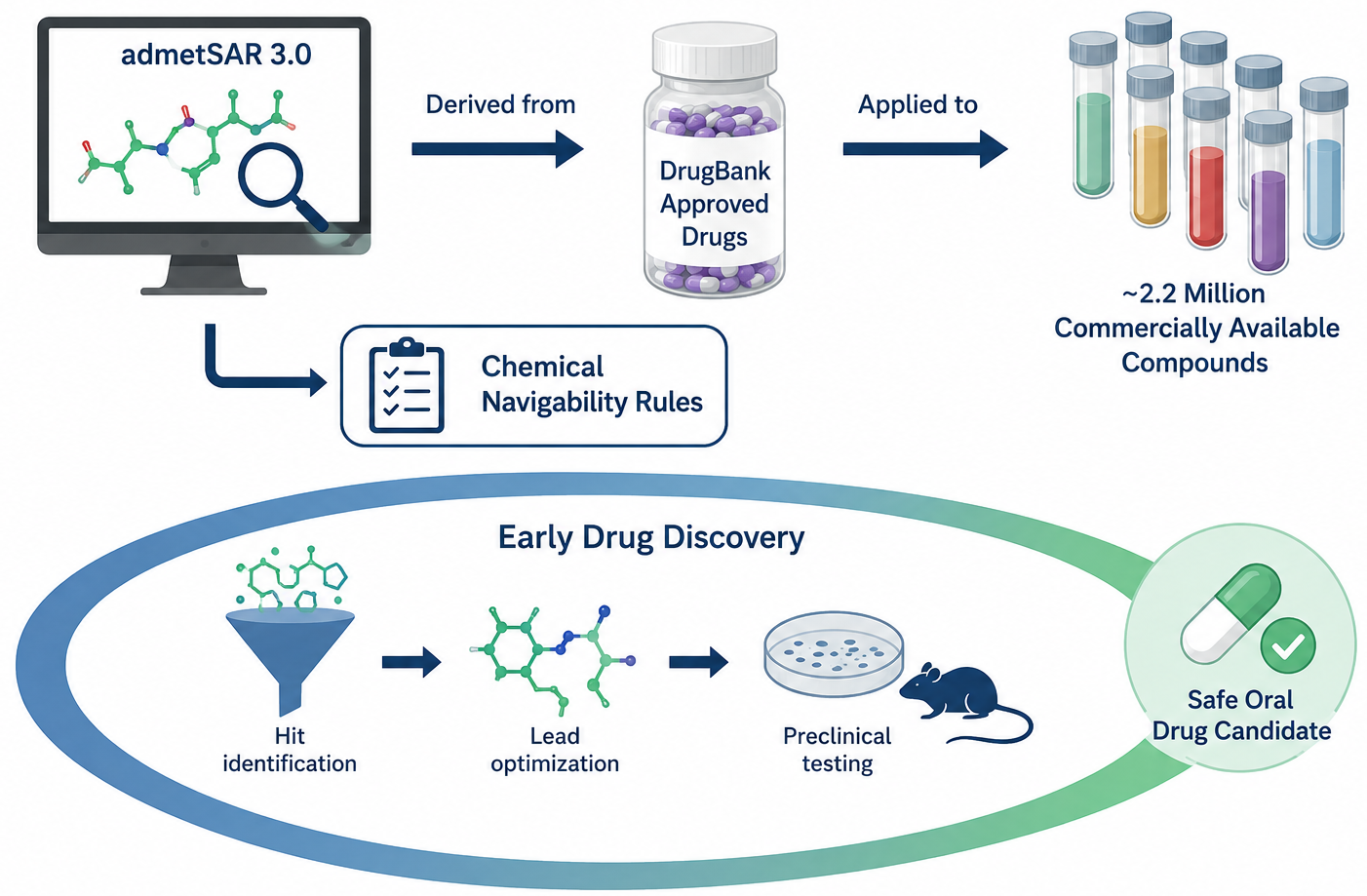 Despite unprecedented advances in structural biology that have propelled Structure-Based Drug Design (SBDD), the drug development pipeline remains constrained by high costs, extended timelines, and a clinical attrition rate approaching 90%.
Notably, a substantial fraction of these failures arises from suboptimal pharmacokinetic and toxicological properties rather than insufficient target efficacy. To address this limitation, SBDD strategies must evolve beyond a sole emphasis on receptor-ligand affinity by incorporating early-stage Absorption, Distribution, Metabolism, Excretion, and Toxicity (ADMET) assessment.
Here, we present a set of empirical chemical navigability rules derived from a comprehensive ADMET profiling of approved drugs curated from DrugBank using admetSAR 3.0. We define threshold criteria for key clinical and preclinical endpoints—including drug-induced liver injury, hERG inhibition, Ames mutagenicity, human intestinal absorption, cytochrome P450 interactions, and blood-brain barrier permeability—enabling the rational prioritization of compounds for central nervous system (CNS) or peripheral targets through an intuitive, color-coded traffic light system.
The utility of this ADMET-first strategy was evaluated using an external, independent library of 1,756 KEAP1/NRF2 modulators from ChEMBL, employing experimentally determined biological activity (pChEMBL) instead of docking-derived metrics. Enrichment analysis demonstrated that ranking compounds according to their ADMET-score identified true actives substantially earlier than random selection, achieving an enrichment factor (EF) of 1.29 in the top 5% of the library and recovering approximately 80% of active compounds within a limited fraction of the evaluated chemical space. These findings support chemical navigability as an ADMET-driven framework for efficient early-stage compound prioritization and virtual screening.
Antonio Cuadrado is the Scientific Director of Servatrix Biomed. S.L.,  a spin-off company of the Autonomous University of Madrid (UAM), established to develop a patent-protected pipeline of NRF2 activators for the treatment of chronic diseases such as NASH. Alongside him, Raquel Fernández-Ginés conducts research at the company, where they focus on the pharmacological regulation of NRF2 (nuclear factor erythroid 2-related factor 2)—a transcription factor that exerts multiple lines of protection against oxidative, inflammatory, and metabolic stress.
We provide a freely accessible, curated database of ADMET-optimized ligands (https://admetSAR.umh.es) featuring advanced combinatorial search functionality. Users can download 3D, docking-ready SDF files of molecules commercially available on MolPort.
To ensure full reproducibility, all custom Python scripts employed in database curation are publicly available through this website.
The web platform https://admetSAR.umh.es is hosted on the official servers of the Miguel Hernández University of Elche (UMH). Developed utilizing standard HTML, JavaScript, and PHP, it integrates a high-performance SQLite search engine. To ensure ultra-fast query execution and seamless data retrieval, the underlying database structure implements comprehensive indexing across all numerical and textual fields. This architecture enables users to efficiently query the database and perform batch downloads of the results, which are available both as comprehensive datasets in CSV format and as compressed ZIP archives containing the corresponding 3D molecular structures.
You can download the datasets used to prepare this website and the scientific article from the following links. They contain compressed files in ZIP format.
  |
Dataset for curated approved drugs registered in DrugBank. Size: 4.28 MB. |
|
Dataset for curated B3DB-ADMETsar3 BBB+. Size: 8.62 MB. |
|
Dataset for curated B3DB-ADMETsar3 BBB-. Size: 5.0 MB. |
|
Dataset for curated library of 1,756 KEAP1/NRF2 modulators compounds from ChEMBL. Size: 3.0 MB. |
 |
MolPort 3D full library with SDF files of 2,260,070 molecules, of which 1,285,720 belong to the "MolPort nonchiral carbon" sublibrary and 974,350 to the "MolPort chiral carbon" sublibrary. Size: 1.54 GB. |
 |
Comma-separated text files compressed with predictions of all parameters calculated by admetSAR 3.0 for the 2.2 million compounds in the MolPort library. MPv8-noQ-01_admetSAR3.zip Size: 481 MB MPv8-noQ-02_admetSAR3.zip Size: 483 MB MPv8-noQ-03_admetSAR3.zip Size: 275 MB MPv8-Quiral-01_admetSAR3.zip Size: 472 MB MPv8-Quiral-02_admetSAR3.zip Size: 449 MB |

|
Video showing how to use the advanced search functionality of the web platform. |
|
|
The file "ADMET-traffic-light-template.xlsm" contains a macro that automatically applies chemical navigation rules to all parameters calculated by admetSAR 3.0, based on the SMILES of the molecules of interest. The following video demonstrates how to send the SMILES file to the admetSAR 3.0 website and then receive a text file with the calculated parameters. It also shows how to use the Excel template to color-code each parameter. |